
Picture this scenario: You've got a growing task list that never seems to shrink, a calendar that looks like a game of Tetris gone wrong, and an inbox that's quietly plotting against you. You know you need help: real, reliable help. But the moment you start thinking about hiring someone full-time, the math becomes uncomfortable. Office space. Benefits. Equipment. Onboarding. Payroll taxes. Suddenly, the person who was supposed to relieve your stress has become a new source of it, and they haven't even started yet.
This is the crossroads that most founders and small business leaders eventually reach. And it's exactly why more of them are choosing to hire a virtual assistant instead. Not as a compromise, but as a smarter, more deliberate business decision.
Let's start with the number that most people underestimate: the true cost of bringing someone on-site.
A full-time in-house assistant earning approximately $40,000 a year doesn't actually cost you $40,000. Once you factor in employer taxes, health benefits, paid leave, equipment, software subscriptions, and the hidden cost of management time, you're often looking at 1.25x to 1.4x that base salary. That's closer to $50,000–$56,000 annually, before you even account for turnover risk.
And here's the part no one talks about loudly enough: the ramp-up period. A new in-house hire typically takes 30 to 90 days before they're operating at full speed. During that window, you're paying a full salary while absorbing the productivity dip that comes with training, onboarding, and all the "where do I find this?" conversations that eat up your week.
None of this makes in-house hiring bad. For certain roles, it's irreplaceable. But for a wide range of operational, administrative, and even specialized tasks? The in-house model carries costs that most SMBs simply can't justify, especially when there's a smarter alternative available.
The virtual assistant cost conversation tends to feel almost too good to be true, until you dig into why it works.
A remote virtual assistant, particularly one sourced through a trusted staffing partner like Tailored Teams, typically comes at a fraction of the fully loaded cost of an in-house equivalent. You're not paying for office overhead. You're not handling benefits administration. There's no equipment to buy, no IT setup to manage, and no long-term commitment hanging over your head if your needs change.
More importantly, when you work with a dedicated staffing partner, the matching and vetting work has already been done for you. That means the person stepping into your workflow isn't starting from zero; they're bringing established skills, professional habits, and often, experience in your exact industry.
The result? You get quality support, without the institutional weight that comes with a traditional hire. That's not a trade-off. That's efficiency by design.
One of the quieter advantages of working with a remote virtual assistant is something founders only fully appreciate after they've experienced it: flexibility that doesn't cost extra.
Business needs are rarely linear. There are seasons of intense activity, launches, campaigns, growth sprints, and seasons where you need to scale back and conserve resources.
An in-house employee is a fixed cost that doesn't breathe with your business. A virtual assistant arrangement, especially one built around your actual needs, can.
Need someone for 20 hours a week to start, with the option to move to full-time if things click? That's a conversation you can actually have. Need a VA who can operate across multiple time zones because your clients are spread across continents? Also on the table, often without any additional cost complexity.
This kind of structural flexibility is particularly powerful for cost-conscious founders who are playing the long game, building lean, staying agile, and refusing to let operational overhead outpace their growth.
Rather than treating this as a philosophical debate, let's make it practical. Here are the questions that should guide your decision.
Does the role require a consistent physical presence in your office or location? If yes, in-house may be necessary. If the work can be done digitally, a remote VA is a strong candidate.
Do you need a deep institutional knowledge-builder who will grow with the company over many years? That weight is better carried by a full-time employee. But if you need excellent execution of defined tasks, a VA delivers that without the overhead.
Is predictability more important than efficiency right now? In-house hires offer continuity and culture-building. But if operational efficiency is your priority, the virtual assistant cost model is hard to argue against.
How confident are you in your own hiring ability? Finding, screening, and retaining talent in-house is a skill and a time investment. When you hire a virtual assistant through a staffing partner, that work is handled by people who do it every single day.
There are certain categories of work where a remote virtual assistant doesn't just compete with an in-house hire; they outperform the model entirely.
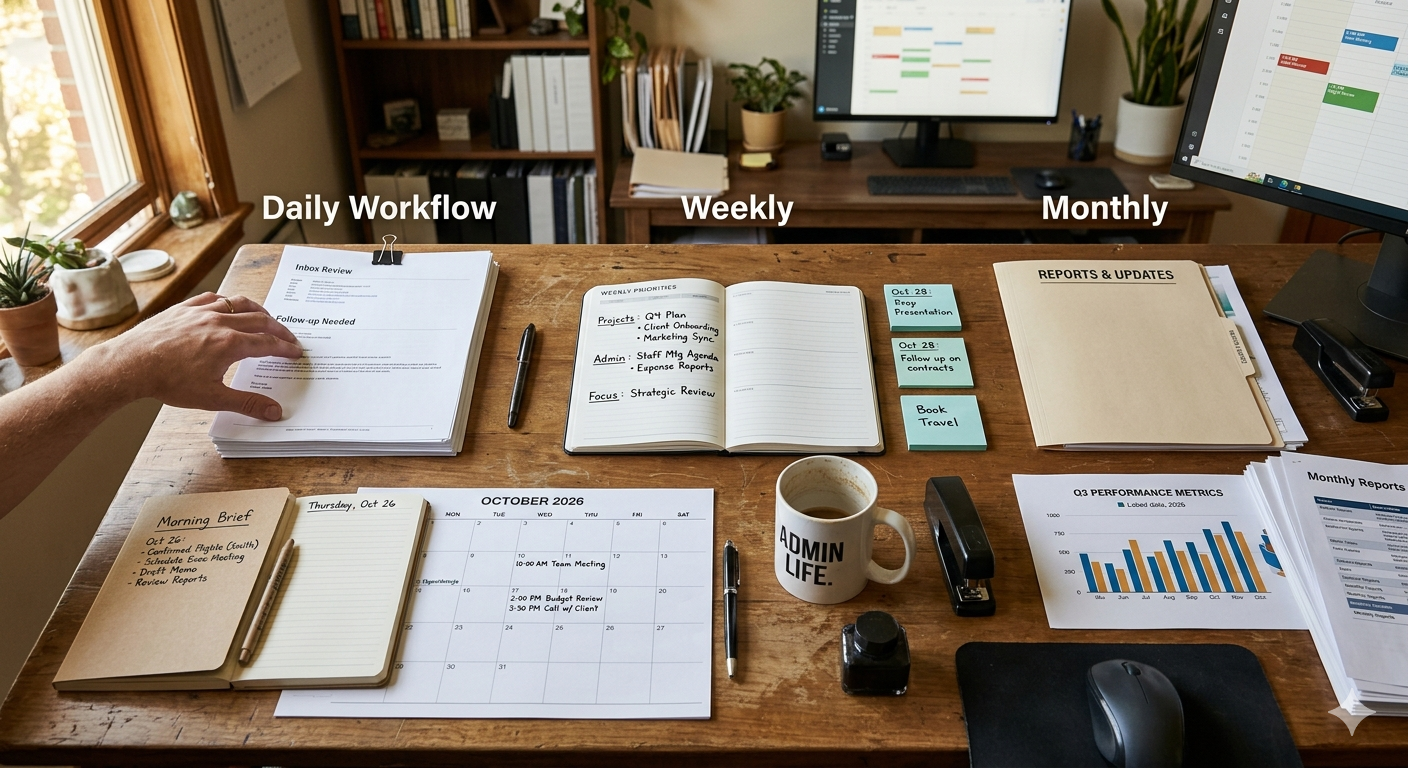
Executive and administrative support is the most obvious: calendar management, inbox triage, travel coordination, and document preparation. But it extends well beyond that.
Customer service and client communication, social media and content management, research and reporting, operations and project coordination, these are all areas where a skilled VA delivers consistent, high-quality output without the overhead of a traditional hire.
For SMB leaders, this isn't a short list. These are often the exact tasks consuming the most time at the executive level, the work that smart founders know they should be delegating but haven't, because the traditional hiring path always felt too heavy to pick up.
The most common hesitation founders have about bringing on a remote virtual assistant isn't really about the cost. It's about trust.
Can someone I've never met in person really handle sensitive tasks, represent my brand, and work with the autonomy I need?
It's a fair question. And the answer lies in how you hire, not whether you hire remotely.
At Tailored Teams, the entire process is built around solving the trust problem before you ever have to experience it. Every VA is carefully matched to the business's specific needs, not just by skill set, but by work style, communication preferences, and cultural fit. You're not rolling the dice on a cold hire. You're getting a professional who has been specifically selected for your context.
Add to that a structured onboarding process, clear communication frameworks, and ongoing support, and the remote distance stops feeling like a gap. It starts feeling like a feature.
Consider a founder running a 12-person consulting firm. She's handling her own inbox, scheduling her own calls, chasing down invoices, and spending Sunday evenings catching up on tasks that her week kept getting in the way of.
She'd thought about hiring an operations manager, but the fully loaded cost of that hire, plus the time investment of finding, interviewing, and onboarding the right person, kept pushing the decision back.
What changed things was realizing that 80% of what she needed wasn't a strategic operations hire. It was a skilled, reliable person to own her calendar, manage her correspondence, coordinate with clients, and keep her week from collapsing into chaos. A remote virtual assistant, properly matched and onboarded, handled all of it. At a fraction of the in-house cost. And without the 90-day ramp-up.
That's not an edge case. That's the story behind most of the businesses that choose to hire a virtual assistant and never look back.
The in-house vs. virtual assistant question doesn't have one universal answer. But for most SMB leaders who are honest about what they actually need, skilled support, operational reliability, and cost efficiency, the case for going remote is compelling.
The virtual assistant cost model is lower. The flexibility is greater. The speed of productivity is faster. And when you have the right staffing partner in your corner, the quality of the match means you're not compromising on any of the things that matter.
If you've been sitting on the decision, waiting for the right moment, the right budget, or the right level of certainty, this is your sign that the model works.
The businesses using it aren't waiting anymore. They're growing. And the ones still doing everything themselves? They're still spending Sunday evenings in their inboxes.
A freelancer completes a project and moves on. A VA becomes an ongoing part of your operations, learning your workflow, matching your rhythm, and delivering value that compounds over time.
It's a fair concern, and it's handled upfront. Tailored Teams builds NDAs and data handling protocols into every engagement before work begins, so confidentiality is structured in, not assumed.
Much faster than an in-house hire. Because the matching is done before day one, most founders have their VA operating productively within one to two weeks.
Both. Today's VAs handle everything from CRM management and content coordination to recruitment support and basic bookkeeping, matched to your specific industry and needs.
Unlike an in-house hire, there's no severance, no rehiring cost, and no months of lost momentum. Tailored Teams works with you to assess fit early and course-correct quickly if needed.

Empowering leadership with tailored executive partnerships.Confidential. Committed. Crafted for performance.