
There's a particular kind of exhaustion that hits founders with 15 to 50 employees. It doesn't announce itself dramatically. It creeps in quietly, disguised as a full calendar, a slightly longer email response time, and a growing sense that you're always one step behind the version of the company you're trying to build.
You're still making decisions. But you're making too many of them. You're still leading. But you're leading reactively. You're still in the room for the conversations that matter. But you're also in the room for the conversations that don't, because no one else has the context to handle them without you.
This is the inflection point. And it's exactly where the question of hiring a chief of staff starts to become less of a luxury and more of a survival mechanism.
Before getting into timing, it's worth clearing up a common misconception. A chief of staff is not an executive assistant with a fancier title. They're also not a COO in waiting, a glorified project manager, or a catch-all for whatever doesn't fit anyone else's job description.
A chief of staff for founders is something more specific: they're the person who sits at the intersection of your thinking and your organization's execution. They translate strategy into coordinated action. They make sure that what you decided in Monday's leadership meeting is actually being tracked, followed up on, and completed by Friday, without you having to personally chase every thread. They attend meetings you can't attend and bring back what matters. They identify the conversations that need to happen before problems escalate to your desk. They manage cross-functional initiatives that don't have a natural owner. They carry the operational complexity of a scaling company so that your mental bandwidth stays pointed at the work only you can do.
Done right, a chief of staff doesn't just support the founder. They multiply them.
Most founders wait too long. The nature of the role is that you don't fully appreciate what a chief of staff could do for you until you've already been underwater for six months. So rather than waiting until the need is undeniable, here are the signals worth paying attention to earlier.
Your decisions are bottlenecking the company. When your team is regularly waiting on you to move forward, on approvals, on direction, on context only you hold, the organization is scaling faster than your bandwidth. That gap has a cost, and it compounds daily.
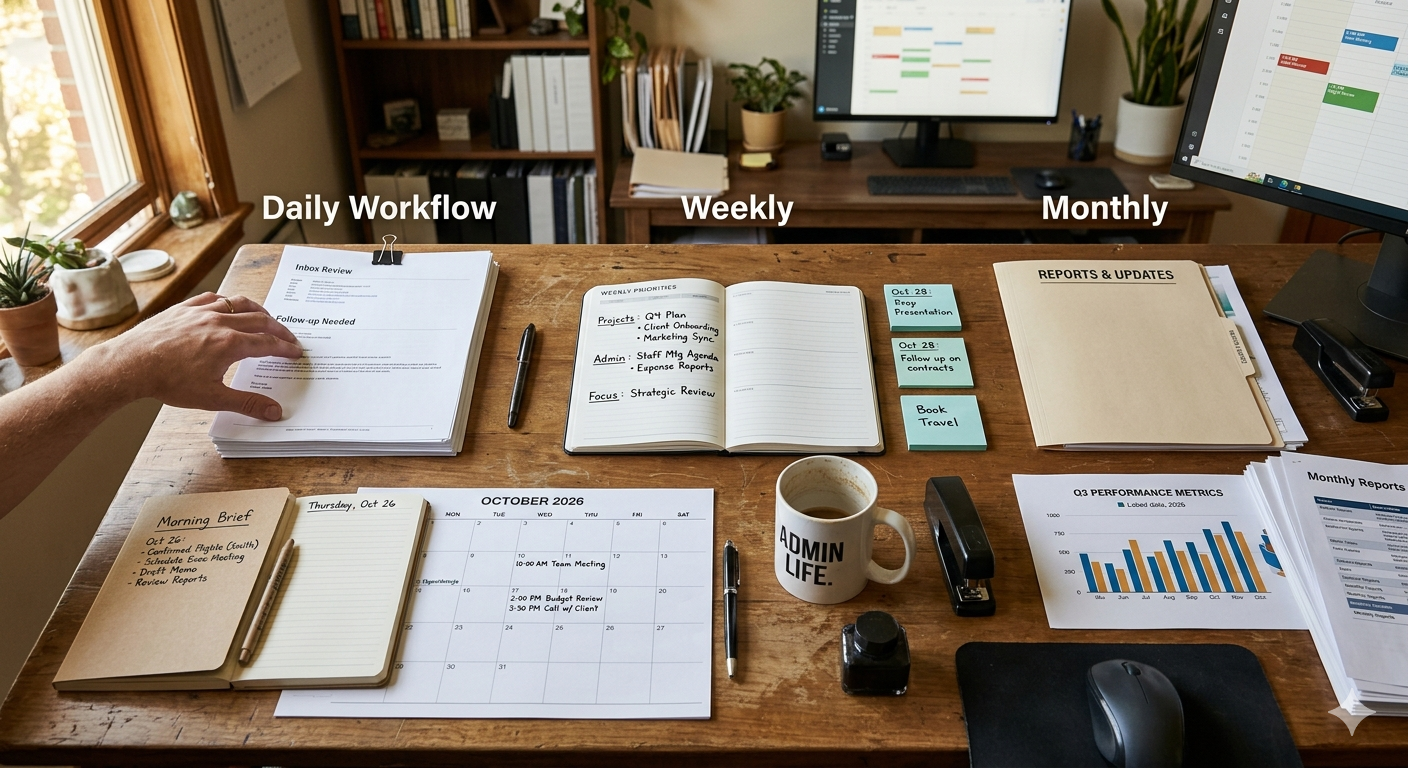
You're spending more time coordinating than thinking. If your calendar is dominated by status updates, alignment meetings, and operational check-ins rather than strategic conversations, something structural has broken. You've become the connective tissue of the company, and connective tissue isn't where founder leverage lives.
Important things are falling through the cracks. Not because your team is incompetent, but because at a certain size, execution requires deliberate coordination that no one currently owns. Commitments get made and quietly forgotten. Priorities shift without everyone getting the memo. Follow-through becomes inconsistent. These are organizational symptoms, not individual ones.
You have a leadership team, but alignment is still fragile. You've hired strong people. But getting them moving in the same direction, on the same timeline, with shared context, still requires more of your involvement than it should. The chief of staff becomes the person who maintains that alignment without it always having to flow through you.
You're thinking about the next 18 months but living in the next 18 hours. This is the most telling sign. If your days are so consumed by the immediate that you rarely have protected time for longer-horizon thinking, the company is running you rather than the other way around.
The chief of staff conversation used to be reserved for large enterprises and political offices. That's changed significantly over the last decade, and for good reason.
A chief of staff startup hire makes particular sense because early-stage and scale-stage companies operate in a state of constant structural flux. Things that worked at 10 people break at 30. Things that worked at 30 break at 75. The organizational chart is always lagging behind reality, which means there are always gaps: initiatives without owners, decisions without clear accountability, and cross-functional work that falls into the space between teams.
In a large corporation, layers of middle management absorb some of that chaos. In a startup, it lands on the founder. A chief of staff is the structural solution to that problem, someone who can operate in ambiguity, build systems on the fly, and hold the organizational complexity that the company hasn't yet grown the infrastructure to handle on its own.
There's also a speed argument. Startups move fast, and fast movement without coordination creates expensive mistakes. A chief of staff keeps the organization oriented without slowing it down, which is a balance that's genuinely hard to achieve any other way.
Knowing when to hire a chief of staff is one challenge. Knowing who to hire is another.
The profile that works is rarely the obvious one. Many founders instinctively look for someone with a strong operational background, a former consultant, an MBA with process chops, someone who can build dashboards and run project plans. Those skills matter. But they're not the differentiator.
What actually separates a great chief of staff from a competent one is judgment. Specifically, the judgment to know which problems to solve, which conversations to have, and which decisions to bring to you versus handle independently. That kind of judgment can't be trained quickly. It comes from experience, intellectual curiosity, and a genuine ability to think like a founder without being one.
You also want someone comfortable being behind the scenes. The best chiefs of staff are not motivated by visibility or credit. They're motivated by impact, and they understand that their impact is measured by yours. If a candidate seems more interested in building their own platform than serving yours, keep looking.
Other qualities worth prioritizing: strong written communication, the ability to hold sensitive information with discretion, comfort operating across all levels of the organization, and a high tolerance for ambiguity. The role is, by definition, undefined at the edges, and that's a feature, not a bug.
"I can't afford it yet."
This one deserves some honest examination. The question isn't whether you can afford a chief of staff. It's whether you can afford the cost of not having one. If your time is worth $500 an hour in strategic output, and you're currently spending 20 hours a week on coordination and operational noise that someone else could handle, that's a $10,000-a-week problem. The cost of the role rarely comes close to that number.
"I don't have enough to keep them busy."
If you're at the inflection point described in this piece, there is more than enough. The challenge is usually the opposite: defining scope clearly enough that the role doesn't try to absorb everything. That's a management challenge, not a workload one.
"My EA already handles a lot of this."
An executive assistant and a chief of staff serve fundamentally different functions. An EA manages your time and logistics. A chief of staff manages your organizational leverage. Both are valuable. Neither is a substitute for the other.
"I want to stay close to execution."
This is the most understandable objection, and also the most worth interrogating. Staying close to execution at scale doesn't mean doing it yourself. It means having someone you trust keeping you informed without requiring your constant involvement. That's what this role enables, not eliminates.
At Tailored Teams, we work with founders who are navigating exactly this inflection point. Not every scaling company needs a full-time, equity-compensated chief of staff from day one. Sometimes what's needed is a highly capable operational partner who can grow into the role, someone who starts by owning coordination and communication, proves their value, and earns expanded scope over time.
We match founders with remote chiefs of staff and senior operational talent who bring the experience, judgment, and work ethic the role demands, without the overhead of a traditional executive hire. It's a way to get the leverage you need at the stage you're actually in, rather than the stage you're planning for.
The question isn't really "when should a founder hire a chief of staff?" The question is: how long can you afford to be the bottleneck?
Every week that passes with your decisions backing up, your strategic thinking crowded out, and your organization running slightly out of alignment, that's compounding. Not catastrophically, not all at once. But steadily, in ways that become harder to reverse the longer they're left unaddressed.
The founders who scale well aren't the ones who do more. They're the ones who get better at directing where their energy actually goes. A chief of staff is one of the most powerful tools available for making that shift.
If Tuesday mornings feel like you're already behind before the day begins, it might be time.
There's no universal headcount, but most founders hit the inflection point somewhere between 15 and 50 employees. The more reliable signal isn't size, it's symptoms: decisions bottlenecking, alignment breaking down, and strategic thinking getting crowded out by daily coordination.
No. An EA manages your time and logistics. A chief of staff manages your organizational leverage, keeping cross-functional work on track, maintaining alignment across teams, and handling the complexity that doesn't have a natural owner. Both roles are valuable, but they solve different problems.
With the right match and a clear onboarding process, most chiefs of staff are making a meaningful impact within the first 30 to 60 days. The ramp-up is faster when the founder invests time upfront in sharing context, priorities, and how they like to work.
Remote works well for this role, provided communication norms are set clearly from the start. The core value a chief of staff delivers, coordination, follow-through, and organizational clarity, translates effectively to a remote setup, especially with the right tools and cadence in place.
A COO typically owns a defined functional area and sits at the executive table with formal authority. A chief of staff operates more fluidly, extending the founder's reach across the organization without owning a specific vertical. Many founders hire a chief of staff first, and some eventually evolve that person into a COO role as the company grows.

Empowering leadership with tailored executive partnerships.Confidential. Committed. Crafted for performance.